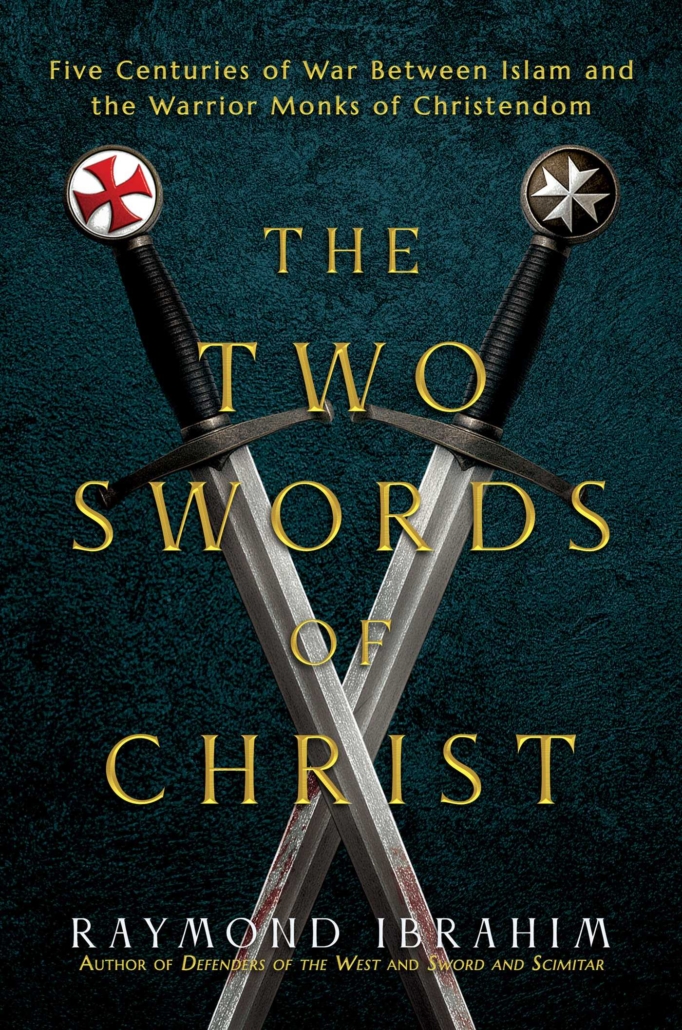
The Two Swords of Christ: Five Centuries of War Between Islam and the Warrior Monks of Christendom Raymond Ibrahim
Bombardier Books, 2025
512 pages, $32.00 hardcover
The average American knows little about Islam apart from the bare fact that it is a “religion.” From this, certain things follow for that average American. First: Islam is a private matter which the state and all non-Muslims are bound to tolerate. Second: when Muslims fail to practice reciprocal tolerance toward non-Muslims, this cannot be due to their religion per se, but must have its source elsewhere—such as in a mysterious process called “radicalization.”
Americans believe these things because of a revolution in religious thinking carried out within Western Christendom in the seventeenth and eighteenth Centuries. This involved a shift away from understanding religion as a comprehensive set of beliefs and rules meant to inform society as a whole and toward considering it an affair of individual conscience. The practical goal of this “privatization of religion” was the worthy one of bringing an end to the destructive wars of religion which shook Europe in the century following the Protestant Reformation.
But the average American is not familiar with this chapter of intellectual history and hence does not understand that the modern ideal of religious toleration is not natural or universal. It is an historical achievement specific to European Christendom. He therefore assumes that the private character of religious belief and the moral requirement upon all of us to tolerate freedom of individual religious conscience are timeless and perhaps even self-evident. This is a good example of what novelist Gore Vidal meant when he famously said that USA ought to stand for the United States of Amnesia. We suffer from the provincialism of time in a way most of our enemies do not.

1 thought on “The Forgotten Legacy of the Church Militant”
Comments are closed.