Stamped and Milled AK Receiver Identification
Some AK parts and accessories are sold for either stamped receivers or milled receivers, and are not interchangeable between the two, so we often get asked: “How do I know whether I have a stamped receiver or a milled receiver?”
The short answer of course, is, “Look at it.” But that’s unhelpful.
The difference is in the method of production. The original AK-47s that Kalashnikov built had milled receivers– the receivers were machined (milled, as in on a milling machine) from a solid block of steel. All the internal guide rails, magazine well and latch surfaces, bolt locking surfaces, bolt carrier stop, and the barrel and buttstock receiving sockets, were cut into the same, single piece of steel. Hence the milled receiver results in a lot of wasted steel, it costs more in terms of machine time, and its a bit heavier. Milled receivers can have one or two stock tangs (single tang receiver shown).
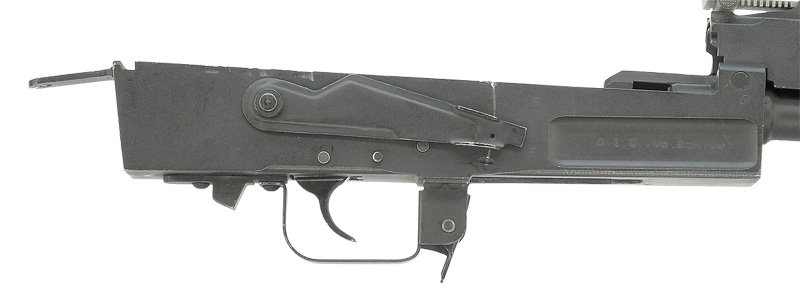
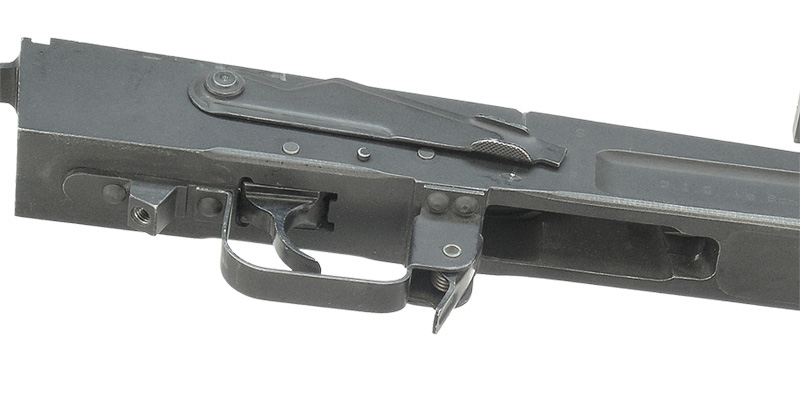
The Milled receiver (above) is one piece of steel. Though you see the trigger and hammer axle pins, and a protruding stop pin for the safety/selector lever, there are no rivet heads protruding from the sides of the milled receiver. There is a large, rectangular-shaped cut for the purpose of weight reduction (lightening cut) above and in front of the magazine well. The trigger guard is stamped, and is riveted onto the bottom of the receiver in much the same way as on a stamped receiver, but the pistol grip nut is attached to the milled receiver (pistol grips are usually interchangeable between receiver types).
The magazine well and magazine front latch slot, like everything else, is machined into the milled receiver, and can be clearly seen below. You can also see where the sharp edges have been milled off (chamfered) above the trigger and magazine for operator comfort. OK, technically, the milled receiver is two parts– The socket into which the back of the lower handguard fits is milled open at the bottom, and then covered with a seperate cover plate to from the bottom surface of the socket for the stock forend (lower handguard).
If you look carefully you can see the faint outline of this cover plate, with rounded corners, starting at the front of the magazine well and extending forward to the front of the receiver. That cover plate allows for four functions. It makes machining easier, it allows for riveting the combination “bullet guide” and bolt kicker cam in place under and behind the barrel breech, it makes for a simpler, square cornered handguard tenon, and it makes room for the stowed cleaning rod: