Skip to content
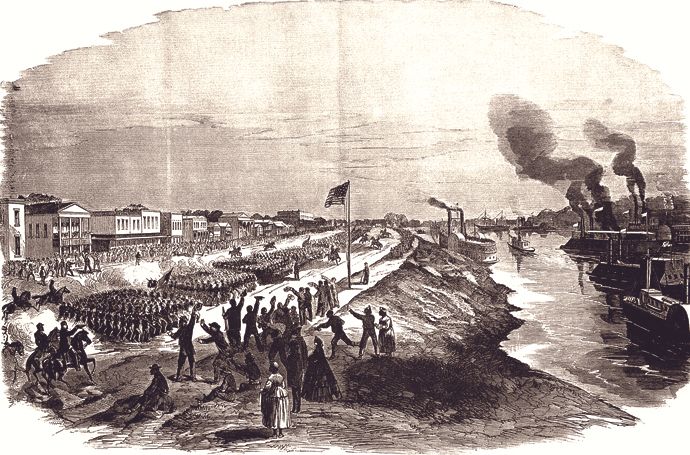
The Yankees occupied New Orleans and its surrounding environs from April, 1862 until the end of the Civil War. In 1863, Gen. Nathaniel Banks left New Orleans to start an advance toward Shreveport. He hoped to seize the busy river port. He followed the Red River upstream. Banks joined with forces under Brig-Gen. Andrew Jackson Smith – who were detached to Banks for this campaign from Gen. Sherman’s army. But, the combined forces were defeated at the Battle of Mansfield on April 8, 1864. Banks then ordered a retreat. The troops under Brig-Gen. Smith had burned and looted the town of Meridan, Mississippi just a few weeks before. They appear to have brought their torches with them on this new campaign in north Louisiana. [1}
Brig-Gen. Smith was extremely angry about the retreat. Having served previously under Grant and Sherman, he chaffed under Banks’ timidity. He was heard loudly berating two of Banks’ division commanders. Too, the troops had arrived on this campaign from the outset determined to “deal their blows very heavily. The people will now be terribly scourged.” [2]
Napoleon P. Banks
Smith’s men were as upset as their commander. On the march back to their rendezvous point with the naval flotilla on the Red River, they sung a marching tune with a line saying they had to “skedaddle.” They sometimes ended their song with a loud yell “Napoleon P. Banks!” They started referring to Gen. Banks as “Mister Banks,” referring to his lack of military training. The retreat was difficult. The Confederate general, Richard Taylor had forces deployed to harry the head of the column, as well as the rear. The Union troops had to hurry to avoid missing the flotilla on the Red River. Nerves began to fray. Smith’s troops devastated the countryside, burning every habitation. They stole everything that could be carried. They applied the lessons they had learned in Meridian. They well-earned the name, “Smith’s gorillas.” Gen. Taylor would later write that the eastern troops, from New Orleans, tried to stop Smith’s troops, but were unsuccessful. Smith’s men continued to burn the world they found all the way to the town of Alexandria, Louisiana. [3]
